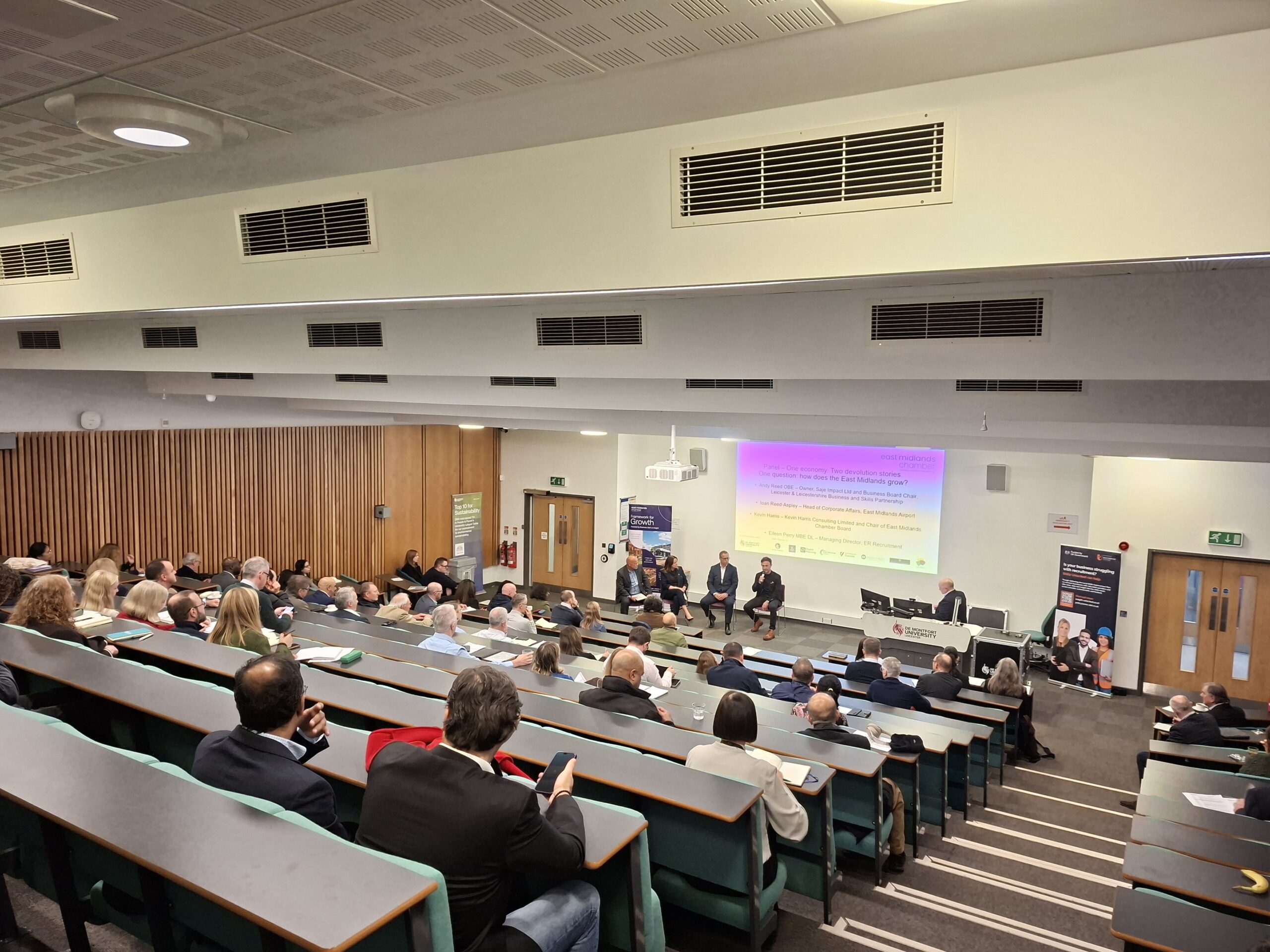
Investment opportunities, technological advances and new powers presented by devolution were among themes explored by business leaders and academics at East Midlands Chamber’s State of the Economy Conference: The Big Growth Conversation on 18th November.
Delivered in partnership with De Montfort University, which hosted the event, and with support from the Bank of England, East Midlands Airport, Derby College Group and ER Recruitment, the conference sought to assess the economic performance of the region across 2026, while identifying growth opportunities for the years ahead.
Building on East Midlands Chamber’s landmark publication the Framework for Growth, a series of talks and panel discussions explored what businesses need to overcome challenges and thrive, to create a more prosperous regional economy.
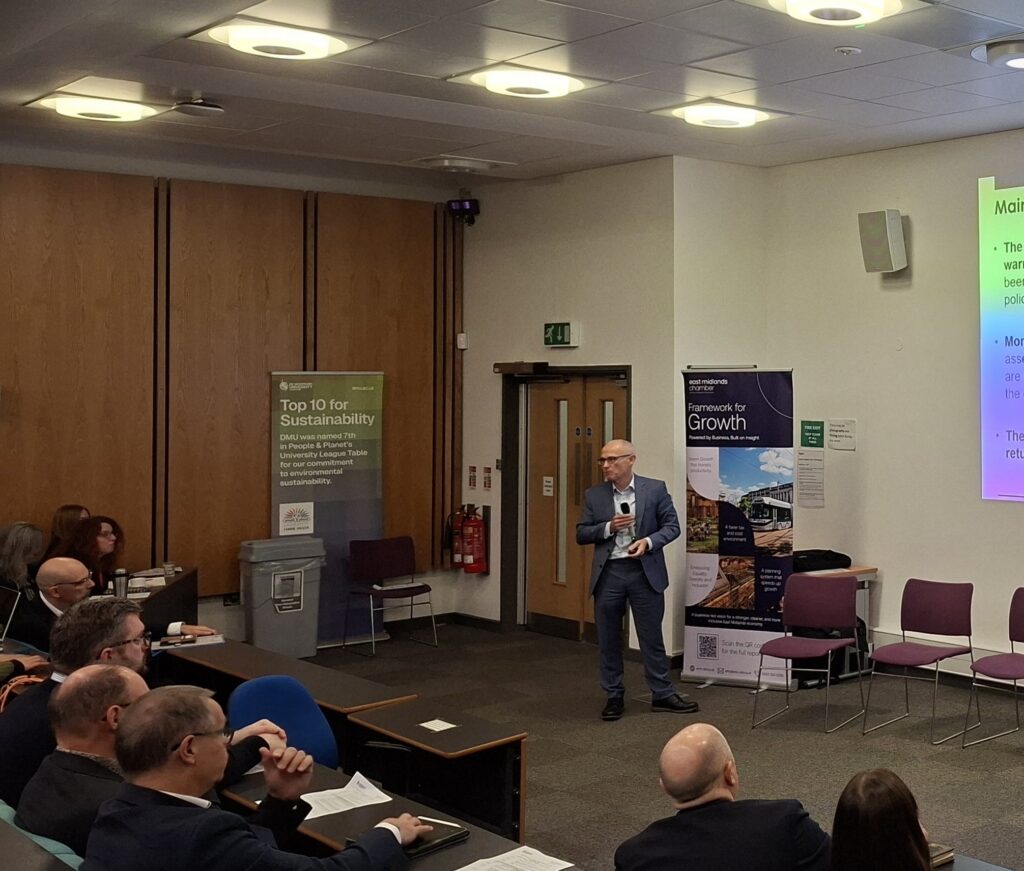
East Midlands Chamber President Dr Cham Kang opened the conference. Speaking afterwards he said: “The East Midlands is a huge driver of the UK economy and boasts skill that’s respected the world over – whether automotive, building trains, the leading research in our top universities, innovation in digital and AI, advanced manufacturing or the creative industries – the potential is there in abundance but it needs to be unlocked.
“Bringing the expertise of academics together with policymakers and the region’s business leaders, which is exactly what this conference was all about, is essential. We called it The Big Growth Conversation as that’s what it is. We need, as a business community, to be collaborating and discussing the future of the region whenever we can.
“What the East Midlands needs is substantial investment to fully enable growth – we cannot have continuation of what has been an historic lack of that. Let’s get the investment we deserve in the East Midlands.”
De Montfort University Principal Partnerships Officer Sarah Thomson gave the welcome talk that introduced the conference. Afterwards she said: “For a region like the East Midlands, engagement between business and academics is essential. The challenge we’re all facing in the UK around how we grow our economies in a sustainable, inclusive way is not something people can do in isolation.
“I feel organisations are waking up to this. Universities like DMU are relentlessly asking ‘how do we help solve these challenges? How do we connect our expertise with the questions that business are looking to answer?’
“It’s about responding to that local need. Events like this conference get the conversation started, people talk about what the East Midlands is really good at, where we’ve got potential to build.”
De Montfort University Pro-Vice Chancellor, Extended Education and Director, DMU London Jill Cowley gave a talk on the role of academia in supporting innovation, productivity gains and skills development. Afterwards she said: “We have to be talking to businesses about their needs, about what they need now and what they need in the future. We have to be responding to that in what we put together as our courses, our packages of learning, our CPD offer – whatever it may be, they have to sit in tandem with each other. They cannot survive without each other.
“We can all get siloed in our thinking about what we’re doing and what we need but we have to come together, share those experiences and be able to challenge each other as well – solutions focused as a conversation. We can’t simply sit in separate bits of the city or the region and expect that collective growth will happen.”
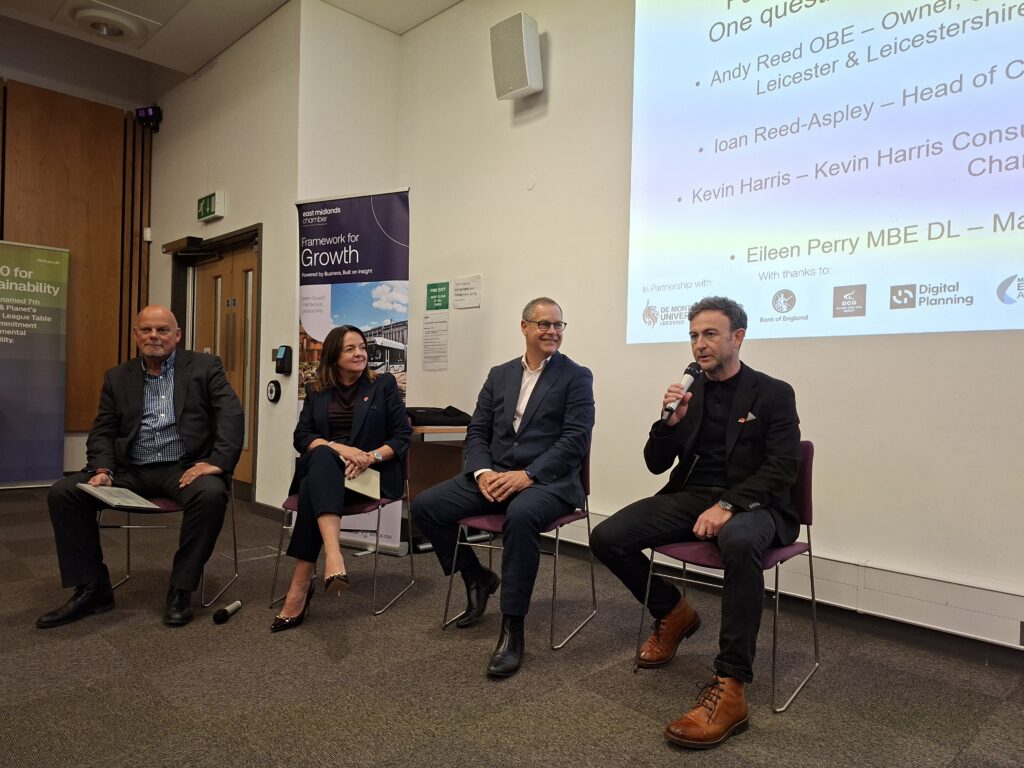
East Midlands Airport Head of Corporate Affairs Ioan Reed-Aspley took part in a panel discussion on devolution and economic growth in the East Midlands. Afterwards he said: “The airport is a real catalyst for growth in the region and not just because of its passenger operation – it’s primarily because of its extensive global freight operation. Businesses decide, choose to invest and locate in the region because they want to be near the airport, particularly those that manufacture goods that need exporting all around the world. It gives them a competitive advantage.
“With assets like the airport in the region, the East Midlands has great potential. At the State of the Economy Conference we’ve talked about some of the barriers to growth and it’s an interesting time with devolution, change of local government, things that can unlock growth in the future. We heard of some of the sectoral strengths of the region – manufacturing was one, logistics and transport another, and the airport provides that global connectivity for the region, which gives it a significant competitive advantage.”
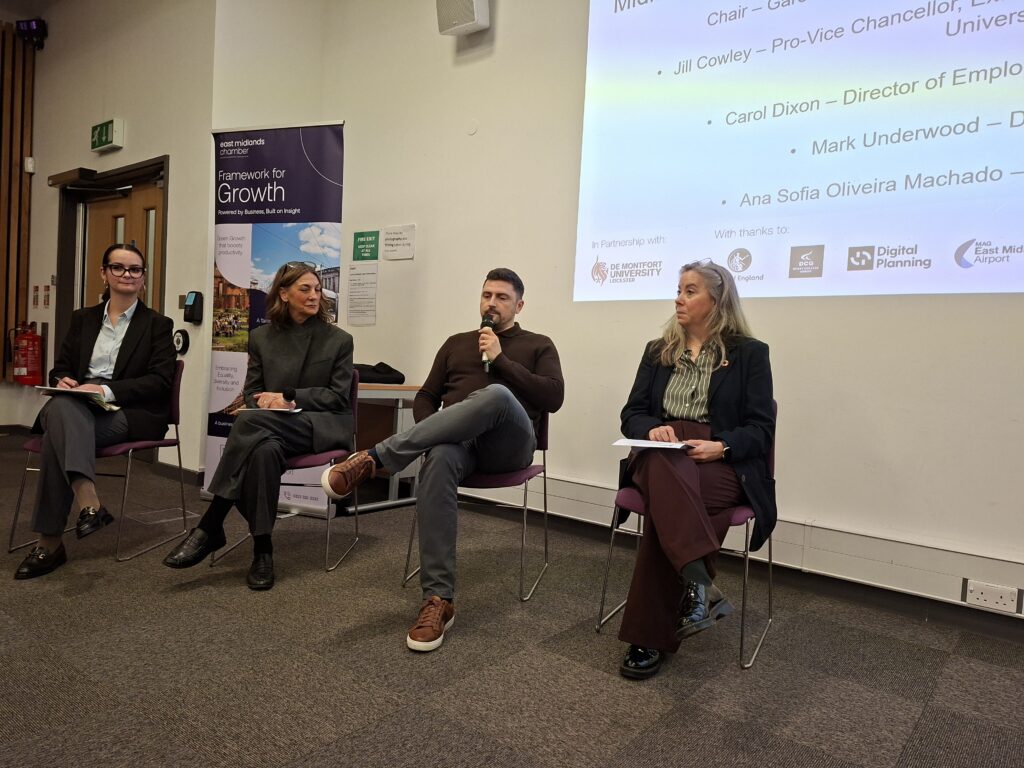
Digital Planning Co-founder and Director Mark Underwood guested in a panel discussion on skills and how the East Midlands can be one of the UK’s fastest-growing regions. Afterwards he said: “Technology is going to move faster than businesses can assimilate reasonably, in terms of how fast they can deploy skills and tools inside their businesses. Change is afoot and some of the businesses I talk to – day in, day out – are woefully underprepared for the scale of disruption that’s about to hit them.
“As we go ahead into 2027 my advice would be to hoover up all the information you can around AI and digital and where things are going over the next few months, six months to a year and really start thinking about getting your tech strategy straight now. Not next year, not in six months, not in 12 months’ time because I feel the whole business landscape is going to be shifting in that time period.”
Pro Excellence Partnership Founding Director Gareth Thomas chaired a panel discussion on getting access to the right skills to overcome barriers to growth. Afterwards he said: “For economic growth in the East Midlands there are two priorities I see – one is essentially driving investment, and in order to get that we need to sort out the devolution situation. We need to get a Mayor in place for Leicester, Leicestershire and Rutland as quickly as possible. Then that drives and helps us secure additional investment from central government.
“The second is to make the skills system easier for employers and individuals to understand and navigate so they can really drive growth in businesses through skills acquisition and development locally.”
Turner & Townsend East Midlands Director Mark Deakin said, after attending the conference: “Getting together, having open conversation around some of the challenges we’ve got and getting positive messages from that is why conferences like this matter. It’s good to talk but we now need action.
“We need good sustainable investment. I’m from a construction background so what I’d like to see is bricks and mortar go up. That’s generally the stimulus for other things to happen but it needs to be sustained and needs to be in the right areas.
“People have got lots of challenges, whether recruitment, retention or ability to be able to put money back into manufacturing and R&D, things like that. I think the biggest challenge is around the continual change we see and the lack of stability that brings.”
National Highways External Lead for the Midlands and East of England Nick Lakin shared his views after attending the conference: “Growth is a fundamental part of how we move the UK’s economy. And National Highways have the strategic road network that’s connecting people and businesses all over the country – and the Midlands is the heart of the UK.
“For every pound you put into transport, you get around three back so it’s a fundamental part of how you move everything around this country, whether transport and logistics, or people and families connecting one another everywhere.”
Speakers and panelists at the 2026 State of the Economy Conference:
- Dr Cham Kang – President, East Midlands Chamber
- Kevin Harris – Chair, East Midlands Chamber
- Eileen Perry MBE DL – Vice Chair of the Board, East Midlands Chamber
- Harsh Shah – Data and Technical Lead, East Midlands Chamber
- Sarah Thomson – Principal Partnerships Officer, De Montfort University
- Paul Mount – Agent, East Midlands, Bank of England
- Andrew Pritchard – Director of Policy and Infrastructure, East Midlands Councils
- Jill Cowley – Pro-Vice Chancellor, Extended Education and Director, De Montfort University London
- Andy Reed OBE – Owner, Saje Impact and Business Board Chair, Leicester and Leicestershire Business and Skills Partnership
- Ioan Reed-Aspley – Head of Corporate Affairs, East Midlands Airport
- Carol Dixon – Director of Employer Partnerships, Derby College
- Mark Underwood – Co-founder and Director, Digital Planning
- Gareth Thomas – Founding Director, Pro Excellence Partnership
- Ana Sofia Oliveira Machado – Student, De Montfort University