With high business costs and increased regulatory pressure adding to a tough trading climate, the region’s firms joined academic experts to address carbon footprint reduction and Corporate and Social Responsibility approaches at the East Midlands Sustainability and CSR Conference 2026.
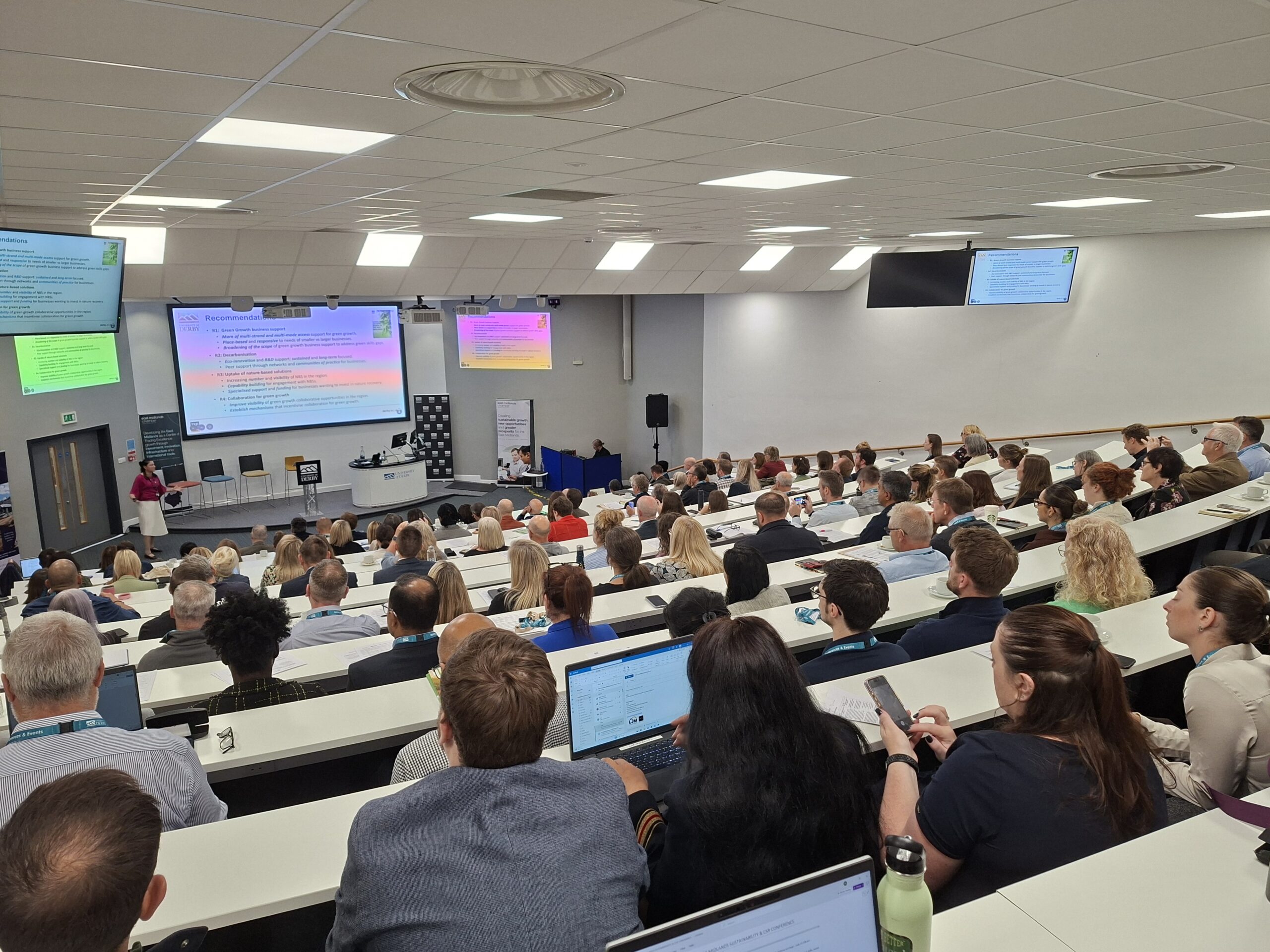
Held by East Midlands Chamber on 10th September, in partnership with and hosted by the University of Derby, sponsored by Auditel and Geo Green Power, business leaders and academics shared best practice and analysis of recent research in a series of talks and panel discussions.
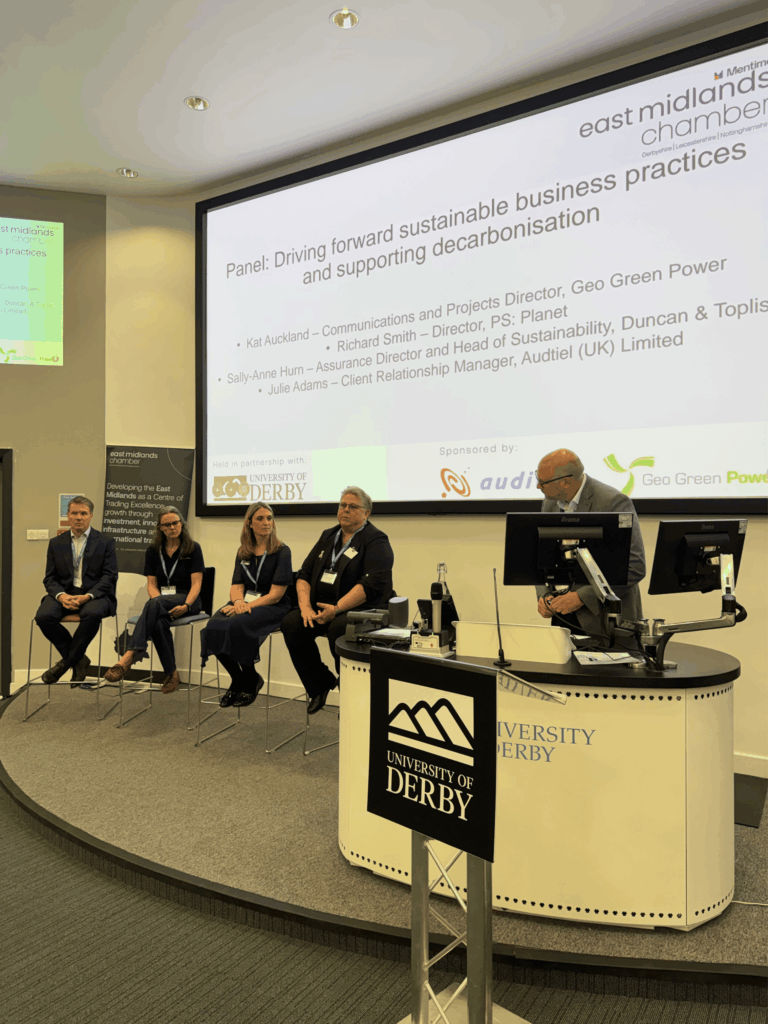
Findings from the Chamber’s 2026 joint report into Green Growth Trends, produced in conjunction with the University of Derby were shared with delegates ahead of publication, which is expected shortly.
The Chamber’s Quarterly Economic Survey data into Corporate and Social Responsibility (CSR) activity was examined by researchers from Loughborough University Business School and the University of Derby, while findings from the recently published Better Business for Nature report, produced by the Chamber with Derbyshire Wildlife Trust and the University of Derby was discussed by panels.
East Midlands Chamber Director of External Affairs Richard Blackmore introduced speakers and chaired panel discussions. Speaking afterwards he said: “Business so often traverses a tightrope, balancing the need to be sustainable and adopt Corporate and Social Responsibility principles with the need to be profitable and financially viable.
“The tough trading climate we’re in right now where high energy costs, rising inflation, business rates, corporate taxation and regulatory pressure are squeezing business can raise questions about where sustainability goals and CSR approaches should be placed and what priority level to give.
“Reducing carbon emissions cannot be a ‘nice to have’ – it has to be in the plan – but with the immense cost pressure on business, it’s essential the approach taken works.
“Getting business leaders together in a room with academic experts, where we can look at detailed research that’s specific to the East Midlands and discuss best practice is invaluable and with the level of challenge on business right now, is more needed than ever.
“Business cannot afford not to have a Green Growth approach, as our soon to be released Green Growth Trends report, produced with the University of Derby will show but its sustainability and CSR approach must work effectively for them and not inhibit financial performance.
“I thank the University of Derby, who we partnered with alongside sponsors Auditel and Geo Green Power, for delivering this very useful conference.”
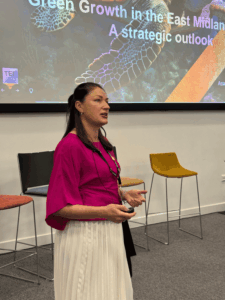
University of Derby Associate Professor of Strategy and Sustainability Dr Polina Baranova shared findings from the soon to be released Green Growth Trends report for 2026, produced by East Midlands Chamber and the University of Derby. Speaking afterwards she said: “There are two major parameters within Green Growth – first, trading on green market niches, which we know is down, so businesses are selling fewer green goods. Secondly, businesses are reducing their involvement in decarbonisation, so they do not invest as much as they would like to. We’ve also seen decline in collaborative activities across the region.
“The positive is that businesses are becoming more aware about supporting nature and engaging more with Nature-based Solutions. In terms of green skills, we know the top five – energy efficiency, resource efficiency, business strategy, digital and waste management – have been consistent over the last three years, which should inspire providers of green skills in the region to hone into the area and provide something for businesses to take off the shelf.
“The Green Growth Trends report is fantastic because you see the picture over time. It’s not isolated and you look at businesses and understand where they’re at. It’s insightful for policymakers to see what the business community is telling us and hopefully informs evidence based decision making.”
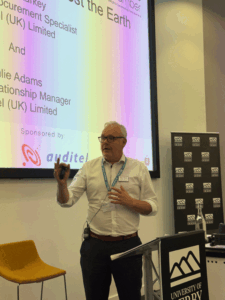
Auditel Carbon and Procurement Specialist Torben Starkey gave a talk on strategic approaches to procurement and carbon reduction to unlock efficiencies, reduce costs and accelerate progress towards net zero. Speaking afterwards he said: “Our message at the conference was around net zero – it doesn’t have to cost the earth. Carbon reduction can and does generate both financial returns and environmental returns if it’s done with the proper systems, proper purchasing, proper data.
“The challenge at the moment is getting SMEs to really want to part with that money, to want to part with that investment. As soon as you’re working with them, they see the benefits immediately. The fact it can also generate financial returns is an added bonus.”
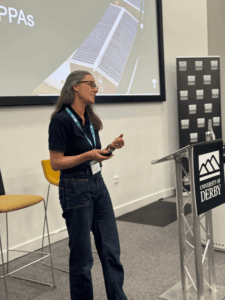
Geo Green Power Communications and Projects Director Kat Auckland gave a talk on Power Purchase Agreements (PPAs) and what businesses need to be aware of. Speaking afterwards she said: “Sustainability is something we’re very passionate about. We wanted to share detail around Power Purchase Agreements. We are aware companies may be struggling to find CapEx investment and additional funds to invest in things like renewable energy installations.
“The PPA route provides an option for companies to go ahead and get the system without having to make upfront cost but does create some nervousness around how contracts are structured. I wanted to share how contracts are made up so people can investigate further.”
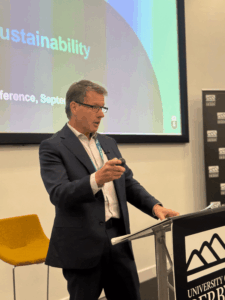
PS: Planet Director Richard Smith gave a talk on the risks incurred by not prioritising sustainability in business. Speaking afterwards he said: “The message I wanted to get across was really to remind everybody of the urgency of the situation globally, in relation to multiple environmental crises and very much including climate change and biodiversity.
“There’s a danger that in sustainability and corporate sustainability circles, with people focused on business, that we focus so much on metrics and the Annual Report – being seen to be doing something – that we actually lose sight of why it needs to be done.
“We’re in a very tricky spot environmentally around the world. We need reminding of what is at stake if we’re not paying attention, if we’re not doing everything we can.
“I don’t think the message is cutting through in the way that it needs to. I think there’s very widespread take up of people doing ‘something’.
“I just want to see businesses take more action. It’s good financially, it’s good socially, it’s good business practice, it’s good reputationally. There isn’t really a downside that I can think of.”
Loughborough University Senior Lecturer in Accounting and Finance Dr Elaine Conway gave a talk on reasons businesses might not engage with CSR. Speaking afterwards she said: “CSR is valued in our region. Over 50% of companies, irrespective of organisational size, micro or large, recognise the value and engage in a wide variety of activities from working with local charities to community engagement and staff engagement, through to environmental activities.
“The important thing about this is that it is not new for the region. The East Midlands business community has always done it and always engaged in CSR. We’ve evidenced that with the Chamber in research since 2019.
“The main underlying reason for this is not because regulation makes us do it; it’s not cost savings. East Midlands business owners and managers say they do it because it’s the right thing to do. They don’t need convincing that operating in a socially responsible way is the right way to do business. That’s despite all the economic headwinds businesses and communities are facing.”
Neurotherapeutics Ltd Chief Operating Officer Richard Cohen took part in a panel discussion looking at the importance of building sustainable links between business and the community. Speaking afterwards he said: “Sustainability and CSR are really important for any business. We heard during the conference how failing to act now is detrimental long-term with impact on businesses and the planet.
“For me personally and from a CSR point of view, enabling the socially inactive right now is important because that leads to growth and helping support businesses in the East Midlands find good talent that’s willing to work, grow and develop.
“The barriers tend to be down to cost – there are hard times now. For businesses looking at it with a cost lens, there’s opportunity to think out of the box and look at how to do more engaging things with CSR, whether that’s talent or looking at prisons for manufacturing – whatever it may be, there’s opportunity out there.”
Speakers & Panelists at the East Midlands Sustainability and CSR Conference 2026:
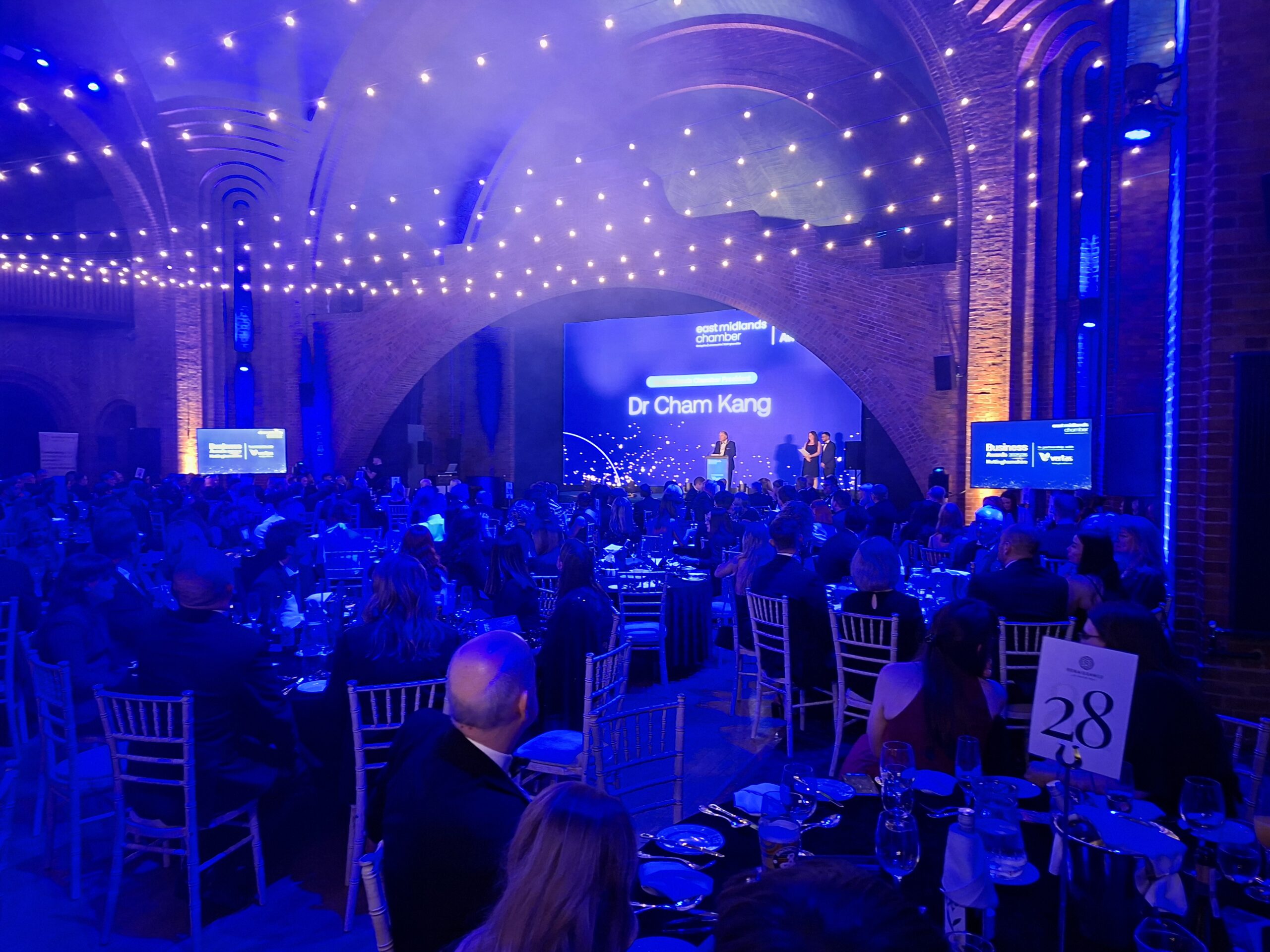
- Dr Cham Kang – President, East Midlands Chamber
- Richard Blackmore – Director of Policy and Insight, East Midlands Chamber
- Dr Polina Barova – Associate Professor of Strategy and Sustainability, University of Derby
- Torben Starkey – Carbon and Procurement Specialist, Auditel
- Julie Adams – Client Relationship Manager, Auditel
- Kat Auckland – Communications and Projects Director, Geo Green Power
- Richard Smith – Director, PS:Planet
- Sally-Ann Hurn – Assurance Director and Head of Sustainability, Duncan & Toplis
- Dr Barbara Tomasella – Senior Lecturer in Marketing, University of Derby
- Dr Elaine Conway – Senior Lecturer in Accounting and Finance, Loughborough University
- Susan Ambler – Chief Financial and Infrastructure Officer, University of Derby
- Caroline Killeavy – Chief Executive, Our Dementia Choir
- Richard Cohen – Chief Operating Officer, Neurotherapeutics Ltd
- Georgiana Bristol – Chief Executive, Jobs Foundation
- Kathryn Hague – Group Head of Marketing, World of Sweets
- Dr Claire Roe – Associate Lecturer, Derby International Business School
- Hollie Fisher – Head of Consultancy, Derbyshire Wildlife Trust
- Dr Alison Lawson – Subject Lead Marketing and Operations, Derby International Business School
- Dr Jenny Lunt – Lecturer in Health Psychology, University of Derby
- Orla Kelleher – Derby International Business School
- Eleanor Atkins – College of Science and Engineering, University of Derby